


THE Thar desert, though being one of the smaller deserts in the world, encompasses the Desert National Park, which is the second largest national park in INDIA.
Desert National Park, commonly referred as DNP, to most nature lovers, is unique and perhaps the only habitat of its type in the Indian subcontinent. The region falls in the extreme hot and arid area of very low rainfall zone of the country.
Passage migrants (birds) start arriving here from the early days in september. Some stay back and some move on to return via the same route by february. Amazingly, they do this year after year.
DNP, presently is the most important site for the survival of the globally threatened (critically endangered) Great Indian Bustard (GIB). DNP is located about 45 kms from the Golden City Jaisalmer, in the North-west state of Rajasthan, India.
The Great Indian Bustard, popularly known as 'Godawan', is Rajasthan's state bird. The state government had started "Project Godawan" to save it from getting extinct at Sudasari region in Desert National Park.
With just a few left in the wild, we (myself, Yash and Seema) set out our journey to see them in the wee hours of 24th Dec 2017. Being approximately 1100 kms from the city of Mumbai, planned our journey through Mount Abu. They are not only amongst the heaviest flying bird on the planet but are much closer to extinction that the tiger!
DNP in general is barren, sandy areas dominated this western part of Jaisalmer district, while gravelly and rocky areas were seen scattered throughout the other areas, with a few isolated ridges.
Our safaris were divided into two, the first that would start by 6am and end by 11am and the second by 3pm through till 6pm. Being winters, the sun sets earlier. The morning and nights are cool, while the afternoons are hot!
Musa Khan, had been in touch with me for almost an year and used to keep us posted on the various sightings in the region regularly. He knew the region and trails quite well.
His first priority obviously was sighting the GIB. No sooner as we stared our safari, we were greeted by a desert cat at the start of the sanctuary.
The moment the cat saw us, rushed into the enclosure. Surely, it felt safer there and soon disappeared.
We continued to drive around the enclosure, that had been made to protect the core area from the local villager's cattle grazing into the grasslands. It is said, the GIB lays only one egg every season and is prone to getting damaged by the cattle that encroach into their territory. This treat is over the above the natural predators of the region the fox, the mongoose and obviously the birds of prey to name a few!
The grass was dry and reasonable high, hence after some distance, we had to stop our vehicle and scan the area. While, we were scanning saw three GIB's fly into another enclosure far away.
We continued our search and sighted another lot of three GIB's. They were moving away from us, obviously they seemed cautious.
Having, sighted the GIB, started to drive into other areas. To us all routes seemed the same, there were tracks of other vehicles too. We did see some isolated dwellings of villagers, who manage to survive in these harsh terrains.
Later, we sighted a committee of vultures.
Though there was no carcass around, the vultures were just roosting and basking.
Evening we visited the desert region, which had these huge undulated layers of sand, which felt like silk.
The desert fox was commonly sighted, in all we could see 4-5 different individuals. Chinkara, the most elegant ungulate is found in large numbers. Slight sound and one can see them run, hop and jump.
The Eastern Imperial Eagle was roosting on the shrub tree and soon took to flight.
As the sunset sighted a couple of Egyptian vultures came and roosted.
The Grey francolin, Variable, Desert and Isabelline Wheatear were very commonly seen.
We sighted the Short-toed snake Eagle too, it was soaring high.
We did see many specimen of the Laggar Falcon's, Common Kestrel's, Long-legged Buzzard's and Cream-coloured Courser's.
The next day we drove towards another important bird area, Ramgarh. En route we sighted the trumpeter finches, who were busy foraging and drinking water.
A loner Red-Tailed Wheatear was seen too. In the far away fields, saw two small flocks (4-5) of common cranes.
We later stopped by the famous Netsi Talab, where we saw common waders of the region, apart from Water Pipit.
Musa Khan, then parked the vehicle a little away and asked us to wait near the talav (water body). Only, minutes later, we realised why, a large flock of chestnut-bellied Sandgrouse started to fly in. They would settle for a few seconds, drink water and fly off!
Seemed like poetry in motion, it was a sight, we will remember for the rest of our lives.
and Jamnagar in Gujarat while returning from DNP towards Mumbai, as we heard about sightings of the Little crake, a migrant from Europe.
Desert National Park, commonly referred as DNP, to most nature lovers, is unique and perhaps the only habitat of its type in the Indian subcontinent. The region falls in the extreme hot and arid area of very low rainfall zone of the country.
Passage migrants (birds) start arriving here from the early days in september. Some stay back and some move on to return via the same route by february. Amazingly, they do this year after year.
DNP, presently is the most important site for the survival of the globally threatened (critically endangered) Great Indian Bustard (GIB). DNP is located about 45 kms from the Golden City Jaisalmer, in the North-west state of Rajasthan, India.
The Great Indian Bustard, popularly known as 'Godawan', is Rajasthan's state bird. The state government had started "Project Godawan" to save it from getting extinct at Sudasari region in Desert National Park.
With just a few left in the wild, we (myself, Yash and Seema) set out our journey to see them in the wee hours of 24th Dec 2017. Being approximately 1100 kms from the city of Mumbai, planned our journey through Mount Abu. They are not only amongst the heaviest flying bird on the planet but are much closer to extinction that the tiger!
DNP in general is barren, sandy areas dominated this western part of Jaisalmer district, while gravelly and rocky areas were seen scattered throughout the other areas, with a few isolated ridges.
Our safaris were divided into two, the first that would start by 6am and end by 11am and the second by 3pm through till 6pm. Being winters, the sun sets earlier. The morning and nights are cool, while the afternoons are hot!
Musa Khan, had been in touch with me for almost an year and used to keep us posted on the various sightings in the region regularly. He knew the region and trails quite well.
His first priority obviously was sighting the GIB. No sooner as we stared our safari, we were greeted by a desert cat at the start of the sanctuary.
The moment the cat saw us, rushed into the enclosure. Surely, it felt safer there and soon disappeared.
 |
| Desert cat - Image by Yash Kothiala |
The grass was dry and reasonable high, hence after some distance, we had to stop our vehicle and scan the area. While, we were scanning saw three GIB's fly into another enclosure far away.
We continued our search and sighted another lot of three GIB's. They were moving away from us, obviously they seemed cautious.
 |
| Great Indian Bustard - Image by Yash Kothiala |
 |
| Great Indian Bustard - Image by Aseem Kothiala |
Later, we sighted a committee of vultures.
 |
| Indian Vulture - Image by Aseem Kothiala |
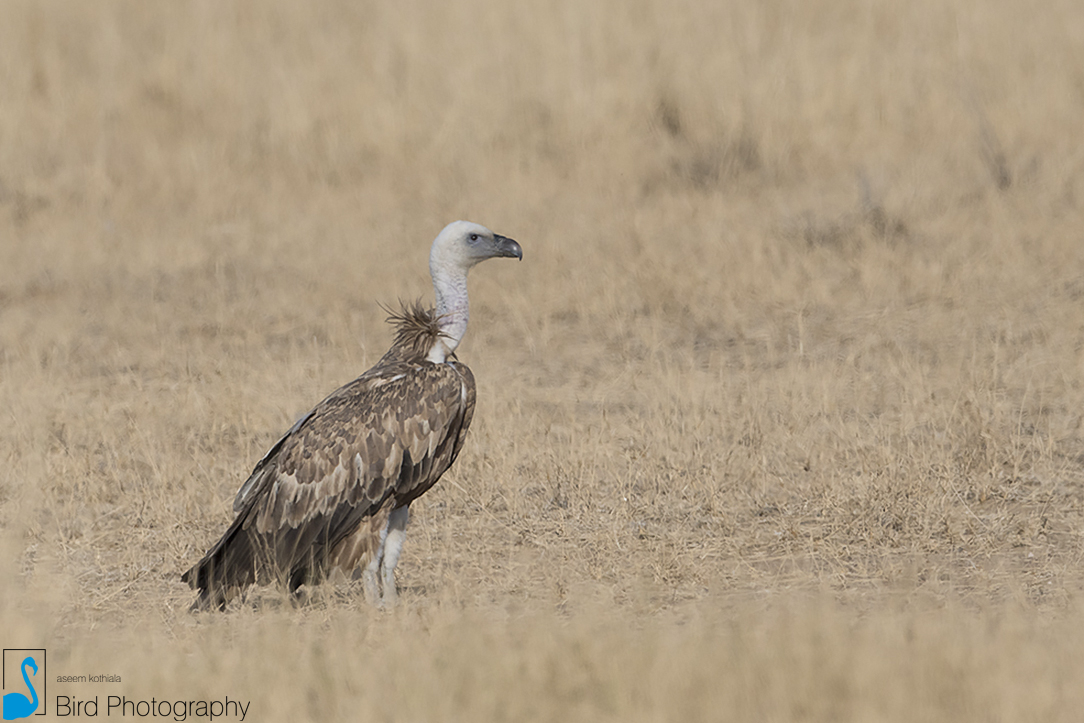 |
| Griffon Vulture - Image by Aseem Kothiala |
Evening we visited the desert region, which had these huge undulated layers of sand, which felt like silk.
 | ||
| Desert Fox - Image by Aseem Kothiala |

The Eastern Imperial Eagle was roosting on the shrub tree and soon took to flight.
 |
| Eastern Imperial Eagle - Image by Aseem Kothiala |
The Grey francolin, Variable, Desert and Isabelline Wheatear were very commonly seen.
 |
| Grey francolin - Image by Aseem Kothiala |
 |
| Short-toed snake eagle - Image by Aseem Kothiala |
 |
| Cream-colored Courser - Image by Aseem Kothiala |
 |
| Trumpeter finch - Image by Yash Kothiala |
 |
| Trumpeter finch - Image by Aseem Kothiala |
We later stopped by the famous Netsi Talab, where we saw common waders of the region, apart from Water Pipit.
 |
| Water pipit - Image by Aseem Kothiala |
As we were returning, saw the Merlin, a winter migrant to the region, it was roosting on a stone along the water body. They usually feed on other birds, that are captured in mid-air.
 |
| Merlin - Image by Yash Kothiala |
 | ||
Chestnut-bellied sandgrouse - Image by Aseem Kothiala
|

The second session was along another region (Nabh Dungar) around Sudasari, Desert National Park, where we could see the Desert lark, Striolated bunting's, Asian desert warbler apart from some ruins (cemeteries of the silk route) from the 13th century.
 |
| Desert lark - Image by Aseem Kothiala |
By the end of day two, we had seen all the key species we had targeted!
Hence, on the last day after taking the morning safari spent the late afternoon on sand dunes, tucked away from the maddening Sam dunes.
Bimaculated Lark's would fly in large flocks mostly more active during the mornings.
 |
| Bimaculated lark - Image by Aseem Kothiala |
The Black-crowned sparrow lark and crested lark were seen foraging on the ground. The most common were the Greater short-toed lark's. All these usually fly low and did take short flights.
DETOURS:
DETOURS:
Mount Abu, Rajasthan for the famous Green Avadavat. (25th Dec 2017)
 |
| Green Avadavat - Image by Aseem Kothiala |
 |
| Little Crake Porzana parva - Image by Yash Kothiala |
In all we had seven lifers from DNP (26th Dec 2017~28th Dec 2017) apart from the Little crake. (30th Dec 2017)
Thanking Musa Khan for being our nature guide and host for DNP. Pradeep Kumar in Mount Abu. Special thanks to Mayuresh Khatavkar who insisted we visit Jamnagar. Kunal Joshi who ensured we reached the site and Ashwin Trivedi ji who sighted the Little Crake and was kind enough to even share the details with us.
Thanking Musa Khan for being our nature guide and host for DNP. Pradeep Kumar in Mount Abu. Special thanks to Mayuresh Khatavkar who insisted we visit Jamnagar. Kunal Joshi who ensured we reached the site and Ashwin Trivedi ji who sighted the Little Crake and was kind enough to even share the details with us.
Happy Birding and wishing all the readers a Happy New Year 2018!
You can connect with me


Do feel free to share
You can connect with me
Do feel free to share


