Indian Pitta

It inhabits scrub jungle, deciduous and dense evergreen forest.

Nilgiri Flycatcher

An endemic resident in the Western Ghats of southern India.

Brown-winged Kingfisher

These kingfisher species excavate their nests in a river mud bank.

Tiger

Tales from the Land of Mowgli

Merlin

Feeds mostly on small birds, capturing them in mid-air in rapid pursuit.

Malabar Trogon

A resident of dense tropical forests.

Malabar Pied Hornbill

This species is omnivorous, taking fruit, fish and small mammals.

Crimson-backed Sunbird

Diet of sunbirds is based mostly on nectar

Golden-breasted Fulvetta

They prefer dense undergrowth, usually dominated by bamboo forest.

Translate

Showing posts with label Route to Kargil. Show all posts

Tuesday, October 2, 2012

Birding in Ladakh - Part Two

Fine morning it was, couple of cups of tea and a great breakfast to begin the day. We packed our backpacks, loaded them on to the vehicle, and moved out of Kargil Town.
Kargil Town
Just to be safe, the driver Rinchen said “We need to re-fuel as due to the tough terrain, not many fueling stations en-route”. While, the tank was being refilled, out we were in the fresh air. Camera in the hand, clicks on the mind. Soon we were on the road again, and this time the climb was even steeper.

Our main objective of the day was to reach Leh town, before dark. But this hadn’t dampened our spirit to look around for Small Monasteries and stop to turn the prayer wheels (locally called Mane), spot birds and stare into hill locks for grazing sheep's and goats. We also stopped by the famous Lamayuru or Yuru Gompa
Mane - The prayer wheel
Black Redstart (Phoenicurus ochruros)
Black-billed Magpie (Pica hudsonia)
Villages - En-route
Sheep and Goats - Grazing on Hill
Chukar - Chicks
Lamayuru or Yuru Gompa
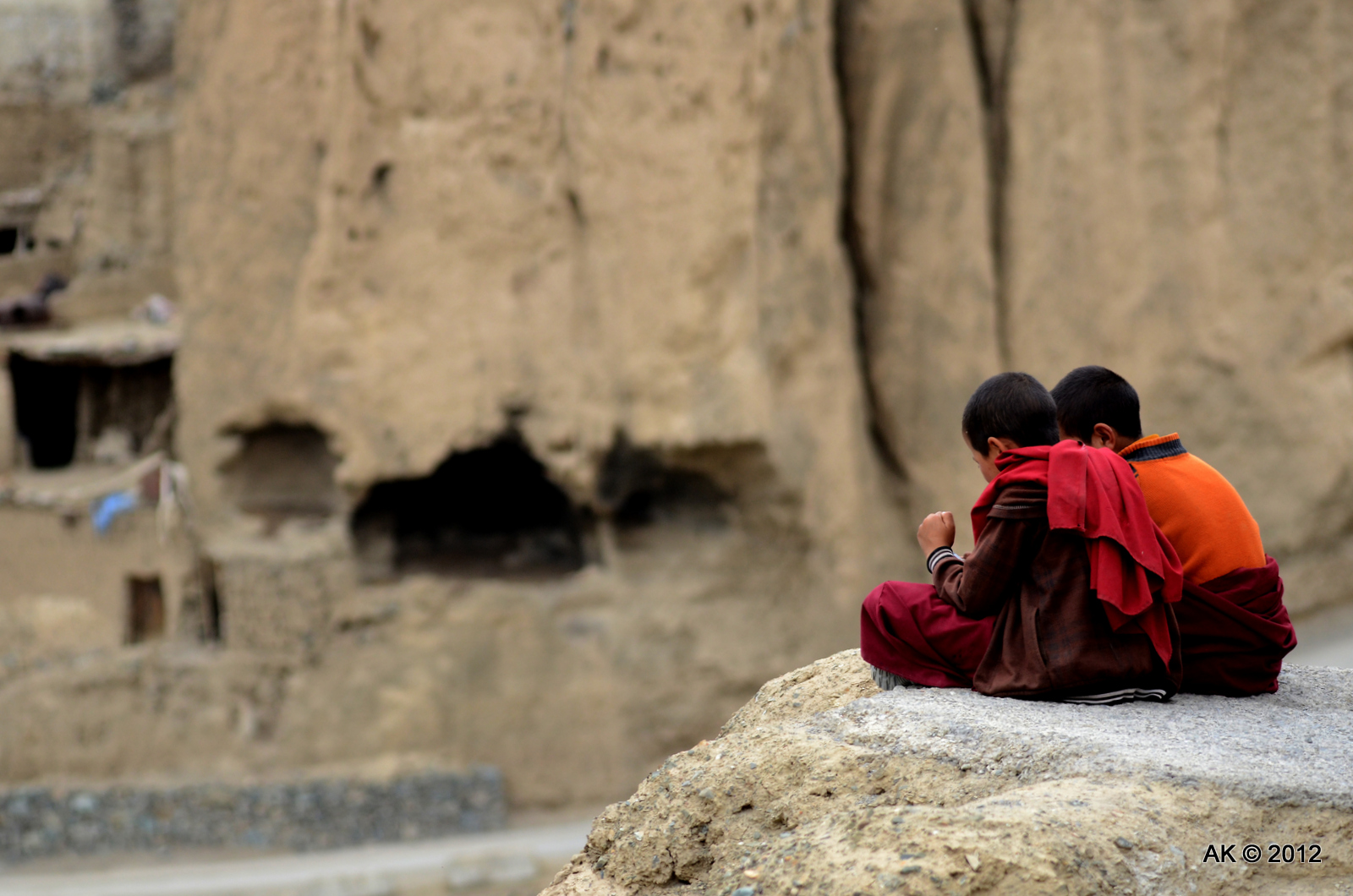
Lama Kids - Outside Lamayuru or Yuru Gompa
As we neared Leh town, we transited through the magnetic hill, which claims to have the capacity to take the vehicle uphill, without driving it!!. 

Rinchen, made us stand out, while Rajesh continued to sit inside. We did see or should i say experience the phenomena. Was it real, was it an optical illusion is debatable.
Drive along the Magnetic Hill
Soon, we were covering the distance, which earlier seemed never ending. As the evening approached, the skies were changes shades and views all around were mystical.
Rainbow
Soon, we reached Leh town. Mahi Resort  is where our bookings were made by Mr. Ramesh Rawat. Ramesh was not only a good friend but also our host for the coming two weeks. He just said a couple of sentences and stressed on them initially. Stay calm, walk slow and drink lots of water!!!

The basic concept was to get acclimatized to the weather and to the altitude of 11,000 ft., as the oxygen levels were really low. We would feel breathless the moment we tried to walk fast. All we did was relaxed in the room and later in the evening took a stroll into the market lane which was situated in the heart of the city. The market  was more of  a medley of shops both old and new. Be it  shawls, woollens or pizzas from Italy could see it all.

After, a proper meal at the Mahi resort, it was time to catch on some good sleep, as the next day we were to head to the Zanskar river for rafting.

Personally, i had never ever done rafting and was a little anxious. Our new driver Rinchen (again a common name) was there at the reception to pick us up.

It was day three and was already falling in love with the mountains. We drove for a couple of hours, on a tiny road. The road had a steady climb and moved along the Zanskar river for about 28Kms.

Finally, we reached the starting point. Here is where we were got the rafting tips. Soon we were into our body suits and felt the gears. The moment we got on the raft, realised that it was self supported. The raft passed through the steep gorges which were carved out, by the river over countless years for sure. The Zanskar gorge has been referred to as the 'Grand Canyon' of Asia by many explorers.

The river is graded as Class IV, and it passed through very remote and difficult to access terrain. By the first hour passed, had gathered the courage and skill. Soon there was a rapid and we were asked to jump, if we wanted to experience the river's water. 

I did jump and within seconds could  feel, i was  frozen and fingers went numb, the water was very cold (around 7 degrees Celsius). Lying on my back, with the safety jacket on, kept floating until the rescue team had a lady from UK who was kayaking along our rafts on the mighty Zanskar River took me back to my raft. 

The dramatic 28Kms return journey through the Zanzkar gorge was completed in about three hours. The journey ends just at the confluence of Indus and Zanskar river near Nimmu town.

For me this is one of the most exotic rafting expedition.

In the winters, the Zanskar river freezes, and the local inhabitants use it for accessing the outer world. While the trekkers’ use it to see the exotic Zanskar village popularly, known as the 'Chadar Trek'.

It was the only day, when the gears were resting in the room.
TwitterFacebookGoogle PlusLinkedInInstagramEmail

Previous Page - Page 1                                
                                        Next Page - PAGE 3

Monday, September 3, 2012

Birding in Ladakh

Journey to the Land of Ladakh

14th August 2012, was the day we headed out to Ladakh which is a part of the Indian state of Jammu & Kashmir much called as the extension of The Tibetan land. (West)

Had read, that Ladakh can offer upto 300 species of birds and is considered an excellent place to sight migratory birds.

As we had included destinations like Kargil, Horse Ride into Rumbak Valley, Rafting On Zanskar river, Drive to Khardung La, and an overnight stay in tents on the famous Pangong Lake. Could only plan to visit Hemis from the other promising Birding spots:
  • ·         The Suru Valley Located at altitude of 2700mts, Suru valley is One of the most beautiful regions of Ladakh.
  • ·         Puga ValleyPuga valley is located in close parimeters of salt lake valley, Well-known for it borax & sulphur deposite this valley has offers great variety of habitat for birds, The valley has combinations meadows, marshes, streams & high rocky slopes.
  • ·         Tso moriri is one of the best birding spots of Ladakh Tsomoriri LakeTso Moriri is situated at altitude of 4595 m . Tsomiri is the largest of the High Altitude Lakes in India. Its a protected area officialy known as "Tsomoriri Wetland Conservation Reserve".
  • ·         Hemis National Park and the Rumbak Valley.
Hemis National park is located on the banks of River Indu, and can be reached from many ways from Leh.


·     Nubra Valley is an incredible valley in North of Leh, approached by Khardung La Pass (5700m), the highest motorable road in the world. Nubra valley has 70km long Siachen Glacier, which is the longest glacier in the Karakoram range.

Day 01: We had packed our backpacks, cameras and lens and took our flight to Srinagar from Mumbai, which transited through New Delhi.

It was a beautiful morning, it was just about 10.30am when we came out of the airport. We could  smell fresh air the moment we drove out of the airport into Srinagar city. The driver Asif, kept showing us sights from the moving vehicle. Most of the important and prominent places were well guarded by the armed forces. Enroute we picked up our driver Rinchen, who was to drive us from the city centre to Leh.

Srinagar Taxi Stand
Richen was short and had very peculiar Tibetan features. We were very excited and were of the opinion that the distance from Srinagar to Leh would be completed in few hours, as the distance was 425 odd kms.

The journey began as we crossed the famous Dal Lake, Moghul Gardens of Chesmashahi, passing through small towns. The lanes would get narrow with locals walking on both sides of the road. Vehicular heavy traffic was making the road even more crowded and soon after negotiating the chaos we were on National Highway No. 1 (NH1)
House Boats on Dal Lake
Dal Lake
Personally, I was shocked to see the width of NH1, barely two vehicles could pass at one time, and many a times, the vehicle from the opposite side had to drive off road, to let us pass.

It was close to 2.30PM and we were hungry and distance we had covered in the past four hours was barely 44 odd Kms. We stopped and ordered some fresh vegetables and lentils at the Dhabba, which was situated along a stream. While, the chef cum manager prepared the stuff, took a stroll along the stream. Birds, is what I was looking for, and birds is what I found… Eurasian Jackdaw, Wagtails, Mynas. Soon, the food was served and with a full tummy, started the journey.

Eurasian Jackdaw
(Corvus monedula)

While, we moved up and were crossing the Zojila Pass, the vital connecting pass between Kargil and Srinagar. It had started to drizzle and could see trucks skidding on the narrow road, which is at the height of about 3528 Meters! In fact it was after a few minutes we realised that we all were concentrating on the road, did not even know, which song was playing on the car audio system…

Just as the evening set in, we reached Kargil Memorial. We got a warm welcome by the Jawan’s there. One of the Jawan’s gave us the complete story, as to how the treaty was broken by the enemy. It was almost a 15-20 minute brief which covered, how the soldier’s laid their lives and took back the lost post. By the time, the brief was over, we all were charged. All we could say was “Jai Hind”


After moving around the museum and the memorial, ordered for hot Maggi Noodles and Masala tea. The climate started to get cooler and soon the jackets were out.

It took us another couple of hours to cover a distance of 45 odd kms, to Kargil town. We could manage to get the rooms for the night, and some dinner. All we had the strength was for getting into the blanket and retiring for the night...
TwitterFacebookGoogle PlusLinkedInInstagramEmail

                                                                                                   Continue reading - PAGE 2...

 
Fatbirder's Top 1000 Birding Websites